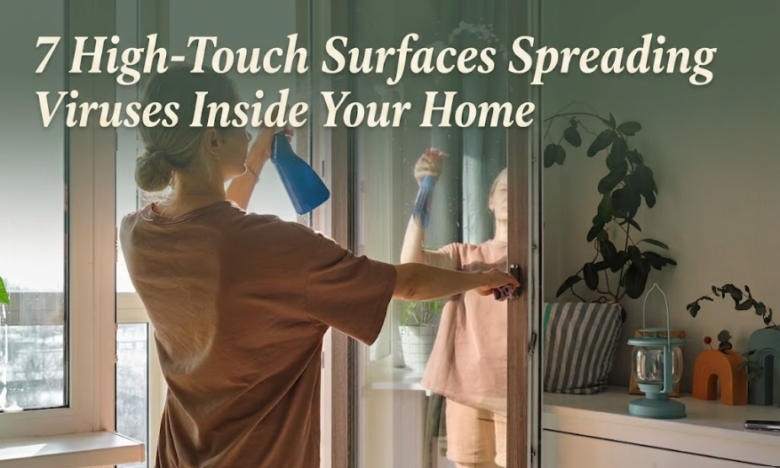
Most people I’ve spoken with over the years assume that getting sick at home means they brought something back from the outside world. The gym, the office, the school drop-off line. And yes, those places matter. But the research keeps pointing to something that doesn’t get nearly enough attention: a significant number of infections circulate within the household itself, passed back and forth through surfaces that get touched constantly and cleaned almost never.
People generally keep their homes fairly tidy. Floors get vacuumed. Bathrooms get scrubbed. But there’s a specific category of surfaces, the ones that get touched dozens of times a day by every person in the household, that tend to slip through every cleaning routine without being addressed. These are the surfaces virologists refer to when they talk about fomite transmission, and understanding which ones matter most is one of the more practical things you can do for your household’s health.
1. Why High-Touch Surfaces Matter More Than Most People Think
When a respiratory or gastrointestinal virus lands on a hard surface, it doesn’t immediately become harmless. Survival time depends on the virus type and the material it’s sitting on, but several common household pathogens stay infectious for longer than most people expect.
Influenza A can survive on hard, non-porous surfaces for up to 24 hours. SARS-CoV-2 has been documented persisting on plastic and stainless steel for up to 72 hours under laboratory conditions. Norovirus, responsible for those miserable stomach bugs that tear through households in winter, can remain viable on certain surfaces for up to a week. Rhinoviruses, one of the main causes of the common cold, have been detected on surfaces for several hours to a few days depending on temperature and humidity.
Fomite transmission, the process of picking up a pathogen from a contaminated object and then touching your eyes, nose, or mouth, is a genuine and well-documented route of infection. It’s not the dominant route for every virus, but for several of the ones circulating inside homes during illness season, it’s a meaningful one.
Here’s a plain-text reference for survival times of common household viruses on typical surfaces:
VIRUS SURVIVAL ON HARD SURFACES (QUICK REFERENCE)
----------------------------------------------------
Virus               | Hard Plastic/Steel  | Copper  | Fabric/Soft
--------------------|---------------------|---------|------------
Influenza A         | Up to 24 hours      | ~1 hour | 8-12 hours
SARS-CoV-2          | 48-72 hours         | 4 hours | ~12 hours
Rhinovirus (cold)   | A few hours to 3 days | <1 hour | A few hours
Norovirus           | Up to 7 days        | ~1 hour | Up to 12 hours
RSV                 | Up to 6 hours       | <1 hour | ~30 minutes
----------------------------------------------------
Note: Survival times are approximate and vary by temperature,
humidity, and surface condition. Based on CDC and published
peer-reviewed data.
That table puts the following 7 surfaces into a different kind of perspective.
2. The 7 Surfaces in Your Home That Are Likely Spreading Viruses
1. Your Smartphone
The average adult checks their phone somewhere around 96 times a day. It comes with them to the bathroom, gets set on restaurant tables, gets handed to children who want to watch a video, and gets pressed directly to the face during calls. And yet smartphones are almost never disinfected.
Research published in journals covering infection control and environmental microbiology has consistently found high pathogen loads on mobile phone surfaces. The smooth glass surface of a phone is particularly good at retaining viruses, and the case is often even worse, especially textured or fabric cases that trap particles in small crevices.
When someone in the household is sick, the phone becomes one of the primary routes of self-reinfection. You touch a contaminated surface, pick up your phone, then touch your face a few minutes later.
2. The TV Remote
The TV remote gets passed around without a second thought. Someone sick on the couch holds it for hours, coughs, switches a channel, sets it down. Someone else picks it up. It ends up in the couch cushions, gets retrieved, gets handled again. Remote controls were flagged in studies of norovirus outbreaks in hotel rooms as among the most heavily contaminated surfaces found, and the same dynamics apply at home.
If there’s one item that should get a disinfecting wipe-down when anyone in the household is symptomatic, it’s the remote. This is one of those places where the gap between how contaminated something actually is and how rarely it gets cleaned is most striking.
3. Kitchen Countertops (Especially Near the Sink)
People think about kitchen hygiene in terms of food safety, cross-contamination with raw meat, safe cooking temperatures. All valid. But the countertop surface near the kitchen sink is one of the most heavily trafficked areas in the entire house.
Hands get washed there, yes, but they also get dried on dish towels that are then placed back on the counter, leaned on while cooking, and used as a staging area for groceries, mail, bags. The surface gets damp regularly, which keeps it more hospitable to pathogens than a consistently dry surface would be. When someone who’s ill moves through the kitchen, this counter picks up whatever they’re carrying, and the next person to prep food or reach for a glass of water touches the same surface.
It’s also worth noting that kitchen sponges are often heavily contaminated. Using a dirty sponge to “clean” this counter can actually make the surface more contaminated, not less.
4. Bathroom Faucet Handles
This one I find genuinely ironic, and I say it because it seems obvious once you think about it but most people never do. You go to the bathroom, you walk to the sink, you turn on the faucet with your unwashed hand, and then you wash your hands. Then you turn off the faucet. With the hand that’s now clean, reaching for the faucet handle that has everything you just washed off.
Unless you make a point of turning off the tap with a paper towel or using your elbow, or unless faucet handles are cleaned separately and specifically, they are among the most contaminated surfaces in the bathroom. Multiple studies across both home and clinical settings have identified bathroom faucet handles as high-risk contact points during illness, particularly respiratory and GI illness.
The fix is simple. A quick wipe of the faucet handle with a disinfectant cloth at the start and end of each day when someone in the household is sick takes about 10 seconds.
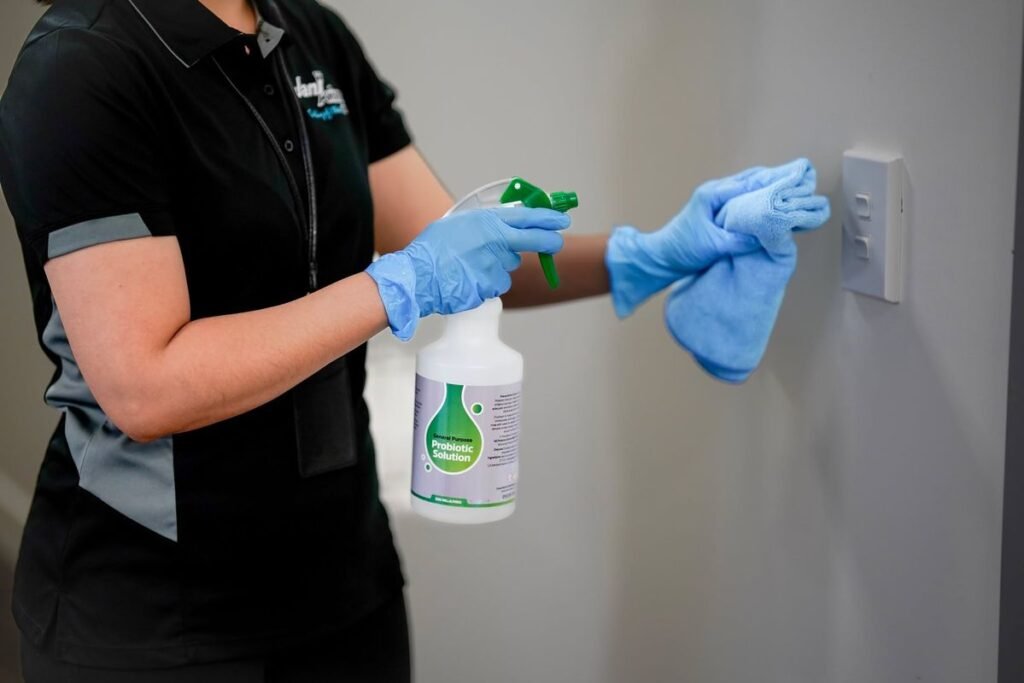
5. Light Switches
People don’t think about light switches at all. Not once. They’re small, unobtrusive, and look completely innocuous on the wall. But they’re touched by every person in the household, multiple times a day, during every single room transition. When someone is sick and moving through the house, every light switch they touch becomes a potential transmission point for every other household member.
Unlike a countertop that might get a visible spill cleaned up or a glass wiped down when it looks dirty, light switches provide no visual cue that they need attention. They just sit there accumulating contact.
If I had to pick one surface that most people would be genuinely surprised to hear about in this context, it’s light switches. The frequency of touch combined with the complete absence of cleaning makes them a reliable, unacknowledged vector in household illness spread.
6. The Refrigerator Door Handle
When someone is sick at home, the kitchen keeps being used. People get hungry. They get thirsty. They go for something to eat every few hours even when they feel terrible. And every single time, they open the refrigerator.
Hard plastic handles are exactly the kind of surface on which viruses like influenza A and SARS-CoV-2 survive for the longest periods. High contact frequency combined with a material that supports pathogen survival makes the fridge handle a real concern during illness season. This is something Daily Health Updates Org has covered in the context of household virus prevention: the surfaces that are both frequently touched and rarely cleaned tend to be where transmission chains in households actually happen.
7. Shared Keyboards and Mice
This matters most in households with children doing schoolwork, adults working from home, or anyone sharing a family computer. Keyboards and mice are handled for hours at a stretch, by multiple people, and they almost never get disinfected. The spaces between keyboard keys are particularly good at trapping particles.
Research conducted on keyboards in clinical environments found they were often more heavily contaminated than floors. Home environments aren’t hospitals, but the principle holds: high frequency of touch, shared between multiple people, and essentially no cleaning creates a surface that moves whatever is circulating through the household from hand to hand.
Wireless keyboards and mice at least don’t have physical connections collecting extra dust and debris, but the touch surfaces themselves carry the same risk.
3. Where the Real Mistakes Happen in Household Cleaning
The most common pattern I’ve noticed is what I’d call the visible-dirt approach. People clean when something looks dirty. The floor has crumbs, the counter has a spill, the bathroom mirror has smudges. But viruses don’t leave visible marks. A spotlessly clean-looking light switch can be carrying an active pathogen load.
The second problem is the assumption that any cleaning is enough. Most disinfecting sprays require a contact time of at least 30 seconds to 4 minutes to actually kill viruses. A quick wipe that doesn’t allow the surface to stay wet for that period may be doing considerably less than expected.
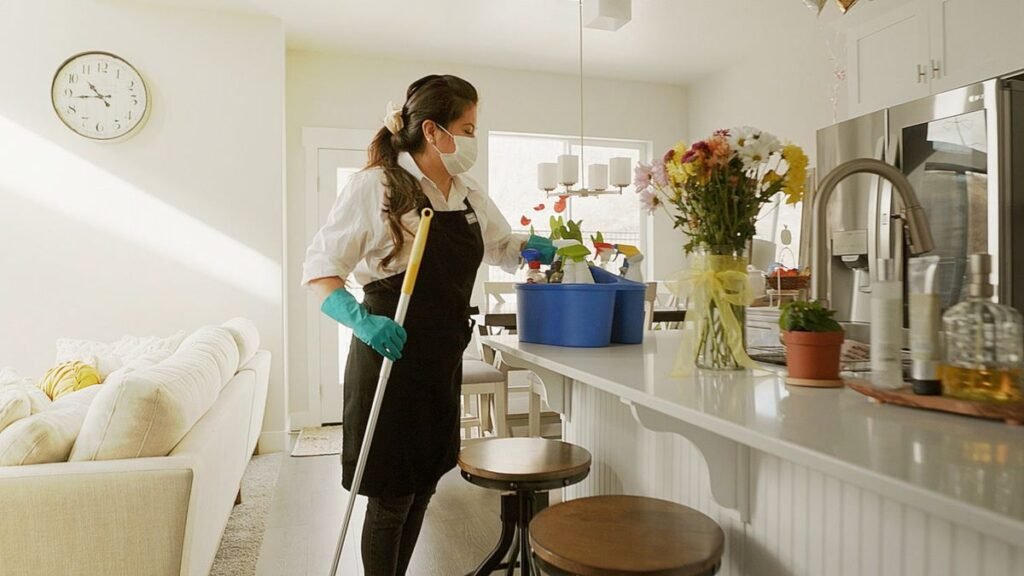
And here’s something that trips people up: soap and water, while excellent for handwashing, isn’t always sufficient for disinfecting hard surfaces against non-enveloped viruses like norovirus. Those viruses have no lipid membrane to disrupt with soap. For surfaces, you need a product specifically labeled as a disinfectant, and ideally one that lists its effectiveness against the specific virus type you’re concerned about. The CDC recommends EPA-registered disinfectants as the reliable standard for household virus prevention.
4. Practical Habits That Reduce Surface Transmission at Home
None of this requires a complete overhaul of the household routine. A few targeted changes make a significant difference.
During illness, clean the highest-risk surfaces once a day as a minimum. The remote, light switches, the fridge and bathroom faucet handles, and any shared keyboards or phones should all get a disinfectant wipe-down with adequate contact time. Focus where touch frequency is highest.
Make weekly smartphone disinfection a normal habit even when everyone is healthy. Most phone manufacturers now confirm that 70% isopropyl alcohol wipes are safe on glass screens, and this habit alone addresses one of the most overlooked virus reservoirs in the home.
Kitchen sponges should be replaced or disinfected regularly. A sponge that sits damp by the sink for days can become more of a contamination source than a cleaning tool.
It’s also worth reading about what makes your immune system better equipped to handle viral exposure in the first place. Daily Health Updates Org has practical resources on that side of prevention, including an article on 7 proven healing tips for virus protection that covers the body’s own defense mechanisms.
Household illness isn’t inevitable even when one person gets sick. Disrupting the surface transmission chain is a real and practical way to reduce how much a virus moves through everyone in the home.
Frequently Asked Questions
Which of these 7 surfaces is actually the most contaminated?
It depends on household behavior more than anything else. But if someone in the household is actively ill, the TV remote and bathroom faucet handles tend to have the highest documented contamination in research on household illness transmission. The smartphone deserves special mention because it combines extreme touch frequency with near-zero cleaning in most households.
How often should I disinfect high-touch surfaces when someone at home is sick?
At minimum, once a day during active illness, focusing on the surfaces listed here. If the ill household member is moving around frequently, a second pass in the evening isn’t excessive. The goal is to interrupt the cycle before pathogens from contaminated surfaces reach someone who hasn’t been exposed yet.
Can viruses on surfaces really cause infection, or is person-to-person transmission the main route?
Both routes are real. For some viruses, like influenza and SARS-CoV-2, respiratory transmission is the primary route. But fomite transmission, picking up a pathogen from a contaminated surface and transferring it to a mucous membrane, is documented as a meaningful secondary route for several common household viruses. Norovirus in particular spreads very effectively through contaminated surfaces.
Does regular household soap and water disinfect hard surfaces from viruses?
For enveloped viruses (the ones with a fatty outer membrane, like influenza and coronaviruses), soap and water can be reasonably effective on surfaces because it disrupts that membrane. For non-enveloped viruses like norovirus, soap and water alone are not sufficient for surface disinfection. An EPA-registered disinfectant that specifically lists effectiveness against non-enveloped viruses is the more reliable choice.
My family shares a single bathroom. What’s the most effective way to reduce transmission when one person is sick?
Wipe down the faucet handles and light switch before and after the sick household member uses the bathroom. Keep their personal items, including their towel and toothbrush, stored separately. And if the illness is GI-related, a diluted bleach solution (typically 1/3 cup bleach per gallon of water) is the most effective option for bathroom surfaces, as many standard disinfectants aren’t sufficiently effective against norovirus.
The home isn’t separate from the question of viral transmission, it’s often the center of it. Most illness cycles that persist in households do so because the surfaces being touched most often are the ones that get cleaned least. Knowing which seven surfaces matter most is the first step. The second step is actually doing something about them, and fortunately, that’s much less complicated than it sounds.