

A client messaged me a few weeks after recovering from the flu, convinced she had caught something new. Her fever was gone. Her body aches had cleared. Her energy was mostly back. But she was still coughing, every day, sometimes into fits that left her breathless, and she had already called her doctor’s office twice asking about antibiotics.
She did not have a new infection.
She had a post-viral cough, and pretty much no one had told her it was a completely normal part of flu recovery. This is a pattern I see constantly: people who get through the worst of the flu only to spend the next month anxious about a cough that lingers and lingers, wondering if they are still contagious, wondering if the antibiotics will finally fix it, wondering why on earth it is taking so long.
The cough is expected. The confusion around it is not.
1. What Influenza Actually Does to Your Airways
Influenza is not just a respiratory infection. It is a tissue injury event.
When the flu virus infects the cells lining your airways, it does not leave those cells intact. It replicates inside them and kills them. The ciliated epithelium, which is the layer of tiny hair-like cells responsible for sweeping mucus and debris upward and out of your lungs, gets stripped away during a moderate to severe infection. What is left is an inflamed, raw airway surface that is exceptionally sensitive to almost anything: air movement, temperature changes, dry conditions, talking, laughing.
This is the mechanism behind the cough.
By the time your immune system clears the virus, usually within five to seven days of symptom onset for most otherwise healthy adults, the structural damage to your airway lining is still very much present. Your body now has to physically rebuild that tissue, and cilia, in particular, are slow to regenerate. Some research suggests full ciliary recovery can take four to eight weeks depending on the severity of the initial infection.
During that recovery window, your cough reflex is also in a heightened state. Post-viral inflammation sensitizes the nerve endings in your airways, so things that would not normally trigger a cough, like breathing cold air or drinking a slightly warm cup of tea, set it off. This hypersensitivity is sometimes called post-infectious cough or post-viral cough, and it is genuinely one of the most common complications of influenza that no one seems to talk about.
2. How Long Is Normal, and the Signs It Is Not
Here is a plain timeline of what typically happens in the respiratory tract after flu:
| Timeframe | What’s Happening in Your Airways | What the Cough Feels Like |
|---|---|---|
| Days 1 to 5 | Active viral infection, peak inflammation | Wet, productive; often with fever and chest tightness |
| Days 5 to 14 | Virus mostly cleared; epithelial damage ongoing | Shifting from wet to drier; still frequent |
| Weeks 2 to 4 | Tissue rebuilding; airway hypersensitivity | Dry, scratchy, easy to trigger |
| Weeks 4 to 8 | Nerve sensitivity resolving; cilia regenerating | Gradually less frequent, quieter |
| Beyond week 8 | Warrants evaluation if still significant | Secondary cause likely involved |
Clinically, a cough lasting three to eight weeks following an acute respiratory infection is classified as a subacute cough. It is distinct from an acute cough (under three weeks) and a chronic cough (beyond eight weeks). Most people with post-flu cough land in that subacute window and fully resolve without any specific treatment.
But eight weeks is a long time to be coughing, and it is reasonable to want to know when something more is going on.
Red flags that warrant a call to your doctor include coughing up blood or rust-coloured mucus, returning fever after several days without one, significant shortness of breath at rest, or a cough that is getting distinctly worse rather than slowly better after week four. These are not panic situations, but they are signals worth acting on. A cough persisting beyond eight weeks with no trend toward improvement also needs evaluation, because at that point post-viral hypersensitivity may have triggered an underlying condition like cough-variant asthma, acid reflux, or chronic post-nasal drip, all of which have their own treatment pathways.
For context on understanding your immune system’s role in how quickly your body manages this kind of recovery, the piece at Daily Health Updates on what your body actually does to fight infection lays out the basics clearly.
3. Why the Remedies People Reach For Do Not Work
This is where the frustration really compounds.
Most people try the same short list of things: a cough suppressant from the pharmacy shelf, maybe throat lozenges, and, very commonly, a course of antibiotics.
Cough suppressants containing dextromethorphan or codeine are formulated for the acute, active-infection phase. They work by blunting the cough reflex centrally, which makes sense when you have an irritated airway that needs a short rest. But post-viral hypersensitivity cough is driven by sensitized nerve endings, and suppressants do not address that mechanism. They may take the edge off temporarily, they do not accelerate recovery.

Throat lozenges and sprays are surface-level interventions. They soothe the throat and provide short-term relief, which is useful, but they have no meaningful effect on airway nerve sensitivity further down.
And then there is the antibiotics issue.
Antibiotics do not work on viral infections. This is widely known. And yet, studies have found that a significant proportion of patients with post-viral cough receive antibiotic prescriptions for it, partly because both patients and clinicians can misread a lingering cough as a sign of bacterial infection. It rarely is. Post-flu bacterial secondary infections do occur, particularly bacterial pneumonia or bacterial sinusitis, but they typically present with specific symptoms: a high fever returning after you thought you had recovered, localised chest pain, significant coloured discharge from the sinuses alongside worsening symptoms. A dry, tickly cough that is slowly improving over weeks does not fit that picture.
I want to be careful here, because I am not suggesting anyone ignore a genuine concern or skip a doctor appointment. The point is that the reflexive assumption that “still coughing” equals “need antibiotics” is worth examining before reaching for the prescription.
For anyone wondering whether their recovery is taking longer because something underlying is affecting their immune resilience, the article on 3 signs your immune system may be weaker than you realize at Daily Health Updates is a useful read alongside this one.
4. What Consistently Helps the Cough Resolve
The honest answer is that time is the primary factor. Airway tissue regenerates on its own schedule and nothing dramatically accelerates it. But there are things that make the process more comfortable and avoid setting it back.
Keep the air moist. Dry air is one of the most common triggers for post-viral cough, and it also slows down mucosal healing. A cool-mist humidifier in the bedroom overnight makes a real difference for many people. Staying well-hydrated does too, because adequate fluid intake supports mucus clearance and keeps airway secretions less viscous.
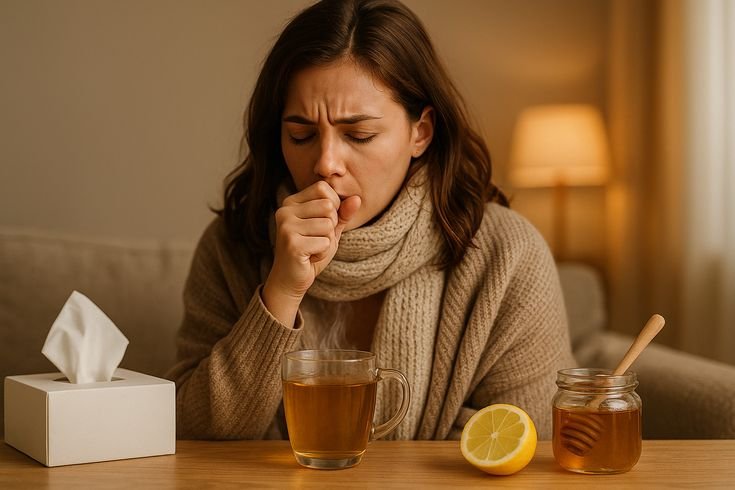
Honey deserves a mention here. A 2021 meta-analysis published in BMJ Evidence-Based Medicine found honey superior to usual care for upper respiratory tract symptom relief, including cough frequency and severity. This is not a home remedy dismissal, it is a finding from a review of multiple clinical trials. A teaspoon in warm water or herbal tea is straightforward, inexpensive, and works through a combination of coating the throat and having mild antimicrobial and anti-inflammatory properties.
Avoid deliberate triggers during the recovery window. Cold outdoor air, smoke of any kind, strong perfumes or cleaning product fumes, dry centrally heated rooms, and talking for extended periods are all common culprits. None of these can be avoided entirely, but being aware of them helps in managing the worst coughing episodes.
Post-nasal drip is worth addressing specifically. A significant portion of lingering post-flu coughs are perpetuated not by airway hypersensitivity alone but by mucus dripping from the sinuses down the back of the throat, which keeps tickling the cough reflex. Saline nasal rinses are consistently effective for clearing this out and are recommended in clinical guidelines for subacute cough management. Sleeping with your head slightly elevated also helps reduce overnight post-nasal drip accumulation.
If the cough is significantly disruptive at night, your sleeping position matters. Lying completely flat lets pooled mucus sit at the back of the throat. A wedge pillow or an extra pillow under the upper back, not just the head, makes a practical difference.
One thing worth considering in the context of slower-than-expected recovery: vitamin D status can meaningfully influence how efficiently the airway epithelium heals and how well-regulated the inflammatory response stays. The Daily Health Updates piece on vitamin D deficiency and winter illness covers this in depth, and it is relevant here because post-flu complications during winter are partly a deficiency story.
And if you are genuinely unsure whether what you are dealing with is a post-flu cough or something else, whether it might be RSV or another respiratory virus that hit during recovery, the RSV vs cold symptom guide can help you sort through the differences.
Most coughs after flu are exactly what they look like: damage that is healing at its own pace. That is genuinely reassuring even when it does not feel that way at week three.
Frequently Asked Questions
Am I still contagious when the cough won’t go away?
Almost certainly not, once you are past the active infection phase. Flu contagiousness typically ends around day five to seven after symptom onset, once the viral load in your respiratory secretions drops significantly. A cough that persists into weeks two, three, or four is driven by airway damage and hypersensitivity, not by live virus being shed. You can cough around people without concern at that stage, though covering your mouth is always good practice.
Why is the cough always worse at night?
Two main reasons. First, lying down allows post-nasal drip to pool at the back of the throat, which constantly stimulates the cough reflex. Second, the airways tend to lose moisture overnight in typical bedroom environments, especially in winter with heating running, and drier airways are more sensitive. A humidifier, slight elevation, and a glass of water nearby go a long way.
Could this lingering cough be whooping cough (pertussis)?
It is worth knowing the difference. Pertussis produces a very specific pattern: prolonged coughing fits that end with a high-pitched inhale (the “whoop”), often to the point of vomiting, followed by a period of exhaustion. It can last weeks and is more common than most adults realize, partly because immunity from childhood vaccination wanes over time. A post-flu cough that is slowly improving and does not involve those coughing paroxysms is unlikely to be pertussis, but if you have any doubt, especially if there are young unvaccinated children in the household, it is worth raising with a doctor.
Can post-flu cough develop into bronchitis?
Post-infectious bronchitis is actually a recognized entity and is one explanation for prolonged cough after flu. It refers to inflammation of the bronchial tubes that persists after the initial infection, and it typically resolves on its own within a few weeks. It does not usually require antibiotics unless a bacterial secondary infection is confirmed. Persistent cough with significant amounts of coloured mucus after day ten of recovery is a signal worth having evaluated.
I’ve been coughing for five weeks and it’s slowly getting better. Should I still see a doctor?
If it is clearly improving, even slowly, that is a good sign you are on a normal post-viral timeline. Five weeks is within the typical range for subacute cough. If it has plateaued at that point or you are having any of the red flag symptoms mentioned above (returning fever, shortness of breath, coughing blood), then yes, a visit is warranted. If it is just slow but trending in the right direction, patience and the supportive measures above are your best tools.