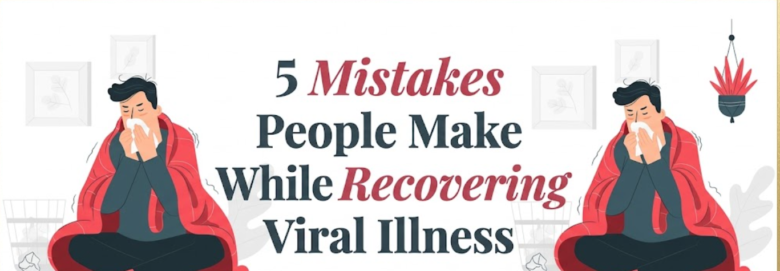
The body’s recovery timeline is longer than the symptom timeline. That’s not a caveat — it’s just how it works. Here are the five patterns that slow things down without anyone realizing it.
The number of times I’ve seen someone return to their normal routine after three days of bed rest, assume they’re fully recovered, and then find themselves flattened again a week later… it’s not a small number. The belief that “feeling better” and “being recovered” are the same thing is probably the most persistent misconception I run into when people are navigating viral illness. They’re not the same thing. Not even close.
What feels like recovery is often your immune system finishing the most visible, symptomatic phase of its work. The fever breaks, the fatigue lightens, the headache fades. But the underlying repair process — the rebuilding of immune cells, the restoration of mucosal barriers, the normalization of inflammatory signaling — continues well past that point. And that gap is exactly where most of the mistakes happen.
The five patterns below aren’t unusual. They’re things most people do instinctively during and after viral illness, and they’re causing real damage to recovery timelines without anyone realizing it.
1. Going Back to Exercise the Moment Symptoms Clear
There’s a version of this I hear constantly: “I took four days off, I feel almost normal, I’m going back to the gym.” And what tends to happen next is that the person feels fine for a couple of days and then spends another week recovering from what should have been a smooth bounce-back.
Exercise is immunosuppressive in the short term. This isn’t controversial in exercise immunology. The period immediately following moderate-to-vigorous effort creates a temporary window of reduced immune surveillance, during which the body is more vulnerable to both new infection and the continuation of an existing one. Under normal circumstances, this window is brief and harmless. During viral recovery, it’s a problem, because the immune system is already mid-task.

The practical guidance is specific: don’t return to normal exercise intensity until you have at least two consecutive days of full, normal energy — not just eased symptoms. Light walking is generally fine earlier. A run, a gym session, a high-intensity class? Wait.
And before you tell me you know your own body, perceived exertion is an unreliable signal during recovery. People consistently overestimate how recovered they are. If you’ve been tracking your symptoms and want a clearer picture of where your immune function actually stands, this breakdown of early warning signs on Daily Health Updates is worth a read before you make that call.
2. Cutting Sleep Short to Catch Up on Everything You Missed
Here’s the irony of post-illness recovery: the thing the body needs most is the first thing people sacrifice the moment they start feeling better.
Sleep is not passive rest. During slow-wave and REM stages, the body releases cytokines, small proteins that regulate both inflammation and immune response. Natural killer cell activity increases. T-cell function is consolidated. Memory about the pathogens the immune system just encountered gets encoded in ways that matter for future exposures. This isn’t metaphor, this is the mechanism.
When someone cuts sleep from eight hours to six to knock out a backlog of emails, they’re not just tired the next day. They’re interrupting processes that have a specific physiological timeline. A 2015 study published in the journal Sleep found that adults sleeping fewer than six hours per night were more than four times more likely to develop a cold than those sleeping seven or more hours. During active recovery, when the body is rebuilding rather than just preventing, that relationship only gets more pronounced.
Sleep debt isn’t easily repaid. One late morning doesn’t undo two weeks of shortened nights. This piece on what poor sleep actually does to immune function goes into the mechanism in more detail. But the short version is: seven to nine hours consistently matters far more during recovery than any supplement you’ll reach for.
3. Under-Eating Because the Appetite Hasn’t Come Back
Appetite suppression during viral illness is a legitimate physiological response. Interleukins — specifically IL-1 and IL-6 — along with tumor necrosis factor suppress appetite as part of the acute phase response. The body is temporarily redirecting energy away from digestion and toward immune activity. This makes complete sense in the first two or three days of acute illness.
The problem is when people carry that same reduced intake into week two. Appetite still feels off, but the acute phase is mostly resolved, and the body now needs raw materials to actually rebuild.
Recovery requires protein. Not in a vague, general-wellness sense, but specifically: antibodies are proteins, cytokines are proteins, and immune cells undergoing proliferation need amino acids as raw material. A person eating minimal food for a week post-illness is giving their immune system nothing to work with. The rebuilding just slows down.
Zinc and vitamin D come up consistently in the recovery literature too. Zinc is directly involved in immune cell proliferation and differentiation, and it’s routinely depleted during acute illness due to increased demand and reduced intake. If you were already running low on vitamin D heading into the illness — which, given population-level deficiency rates, is surprisingly common — recovery can be measurably longer. Daily Health Updates has a detailed look at how vitamin D deficiency intersects with getting sick, and the same principles apply during the recovery period.
Eating might feel unappealing. Eat anyway. Protein-forward, nutrient-dense, small amounts frequently if that’s easier. The appetite comes back faster when you’re actually fueling the process.
4. Using Antibiotics for a Viral Illness, or Pushing for Them
This one is worth naming directly because it happens a lot, and it has downstream effects that people don’t connect back to the original illness.
Antibiotics don’t touch viruses. They target bacteria through mechanisms completely irrelevant to how viruses replicate: disrupting cell wall synthesis, inhibiting bacterial protein production, interfering with bacterial DNA replication. Taking amoxicillin for influenza does nothing to the virus. What it does do is disturb the gut microbiome at a moment when that microbiome is already somewhat compromised from the illness itself.
The gut is not peripheral to immune function. Roughly 70 percent of immune tissue is gut-associated (GALT, or gut-associated lymphoid tissue), and the microbial communities living there have measurable effects on how the immune system behaves systemically. Post-viral antibiotic use without a confirmed bacterial co-infection introduces disruption at exactly the wrong time.
Now, this doesn’t mean never take antibiotics — I want to be clear about that. If a doctor confirms a secondary bacterial infection, take them as prescribed and finish the full course. But if a prescription is being offered as a “just in case” precaution during viral illness, that’s a conversation worth having. The risk of antibiotic resistance isn’t abstract, and neither is the cost to your gut microbiome right when it needs to be stable.
5. Stress-Loading the Moment You Feel Better
The pattern looks like this: four or five days of being sick, inbox untouched, calls missed, plans cancelled. The moment energy returns, the instinct is to sprint. Catch up on everything at once. Reschedule the meetings. Make up for lost time.
Cortisol is why this matters. Acute psychological stress reliably elevates cortisol, and elevated cortisol has well-documented immunosuppressive effects, specifically reducing natural killer cell activity, suppressing T-lymphocyte proliferation, and downregulating certain cytokine production. The research on stress and viral susceptibility is fairly robust. There’s a detailed piece on the stress-virus connection at Daily Health Updates that covers one of the more striking controlled experiments on this topic, and the findings are hard to dismiss.

The point isn’t to eliminate all stress permanently. It’s that the first 48 to 72 hours after recovering from viral illness is a particularly poor window to run yourself ragged, because the immune system is still in a maintenance and consolidation phase, and elevated cortisol is direct interference with that process.
Gradual re-entry isn’t a luxury. It’s physiologically smarter.
Quick Reference: The 5 Recovery Mistakes at a Glance
| Mistake | Why it slows recovery | What to do instead |
|---|---|---|
| Exercising too soon | Creates an immune-suppressive window post-exertion | Wait for 2+ days of full normal energy, not just eased symptoms |
| Cutting sleep short | Disrupts cytokine release and immune cell consolidation | Maintain 7–9 hours consistently through the recovery window |
| Under-eating post-illness | Starves immune cell rebuilding of protein and micronutrients | Eat protein-dense food regularly, even with reduced appetite |
| Taking antibiotics for viral illness | Disrupts gut microbiome and gut-associated immune tissue | Antibiotics only for confirmed bacterial co-infection |
| Stress-loading on return | Cortisol suppresses NK cells and T-lymphocyte proliferation | Gradual re-entry over 48–72 hours post-symptom resolution |
The frustrating thing about these mistakes is that they all come from a completely reasonable place. You feel better. You want your life back. There’s a backlog of things that didn’t happen while you were sick, and the impulse to hit the ground running makes total sense.
But the body’s recovery timeline is longer than the symptom timeline. The immune system doesn’t flag you with a notification when it’s fully rebuilt. There’s no visible signal for when the microbiome has stabilized, NK cell counts have returned to baseline, or the cytokine environment has settled. You just have to give it the time and conditions it needs.
For most people, that means actively resisting the instinct to sprint the moment the worst is over.
Frequently Asked Questions
How long does it actually take to fully recover from a viral illness?
Symptom resolution and full immune recovery are different timelines. For influenza in otherwise healthy adults, symptoms typically resolve within 5 to 7 days, but immune reconstitution can continue for 2 to 3 weeks. For more severe illnesses or people with lower baseline immune function, recovery extends further. A practical guideline is to keep physical and psychological demands reduced for at least 7 to 10 days post-symptom resolution, not just until you feel okay.
Can I still be contagious after I feel better?
For many viral illnesses, yes. Influenza typically peaks in contagiousness during the first couple of days of illness, but viral shedding can continue for up to a week after symptom onset in healthy adults, and longer in immunocompromised individuals. Feeling well doesn’t mean you’re no longer shedding virus. This matters especially when returning to shared spaces or households with older adults or anyone who is immunocompromised.
What should I actually eat to support immune recovery?
Protein is the highest priority because antibodies and immune cells need amino acids to synthesize. Eggs, fish, legumes, dairy, and lean meat are all solid options. Beyond protein, zinc-rich foods like pumpkin seeds, beef, chickpeas, and cashews support immune cell proliferation. Vitamin C from citrus, kiwi, or bell peppers supports mucosal barrier repair. If sun exposure has been minimal during illness, short-term vitamin D supplementation may be worth discussing with a doctor. The specifics matter less than consistent, varied, nutrient-dense eating across the whole recovery window.
Why do I feel better one day and then worse the next during recovery?
This fluctuation is common and reflects the non-linear nature of immune response. Inflammatory signaling doesn’t switch off cleanly — it modulates gradually, and the energy cost of ongoing immune activity can create days where fatigue or mild symptoms return even after an apparently better period. Overdoing activity on a good day is a frequent trigger for this pattern, which is a big part of why the “feeling better means recovered” assumption causes so many problems.
Does drinking alcohol slow down recovery from viral illness?
Yes, measurably so. Alcohol impairs immune function through several routes: it disrupts cytokine production, reduces natural killer cell and macrophage activity, disturbs sleep architecture so you get less of the restorative slow-wave sleep where immune consolidation happens, and it depletes zinc. A glass of wine on day four because you feel almost normal introduces more disruption than most people realize. Waiting until you’ve had a full week of normal energy and sleep before reintroducing alcohol is a reasonable guideline.